|
|
QS9000 Certified Hayes Lemmerz Akron Operations428 Seiberling Street |
|
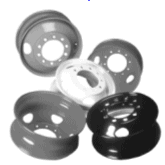
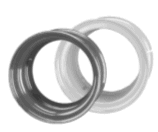
| 1 | Determine operating conditions plus tire size, type, pressure and load. |
| 2 | Refer to Tire/Rim Size Selection chart in this section for tubeless and tube-type tires. |
| 3 | Select rim width and check dual spacing on Dual Wheel/Rim Spacing page and Dual Spacing for Demountable Rims on Cast Spoke Wheels page, both contained in this section. |
| 4 | Refer to rim/wheel specification pages. Select appropriate part number for load and pressure rating, type of mounting, offset, rim width, and tire diameter. |
| 5 | Select attaching hardware for disc wheels or demountable rims. |
| 6 | Determine spacer width for demountable rims and then select spacer. |
When choosing the correct wheel or rim, it is important to determine the operating conditions to which the wheel or rim will be subjected. Conditions to consider are loads, speeds, road environment, tire pressure, tire sizes and tube-type or tubeless tires.
Consult wheel and rim application engineers at Hayes Lemmerz for wheel/rim load and inflation ratings and application recommendations for conditions such as high-center-of-gravity loads, Canadian highway operation, and on-off highway, restricted speed, or severe service operation.
Ratings
Maximum load rating and maximum inflation rating for highway service are
listed with each wheel and rim part number on the application tables in
this section.
Rim Width
Design rim width is the specific rim width used with a basic tire size.
This rim width will give the best overall tire performance.
Other approved rim widths may offer advantages or provide solutions
to specific problems.
|
|
WARNING Rim and tire servicing can be dangerous. To protect life and limb, be sure you understand and follow all mounting, demounting, maintenance, inspection, operational procedures, and safety instructions and practices. For complete information, call (800) 521-0515. |